Songdo Edge Intelligence
A multi-process Linux edge node that keeps sensing, deciding and acting when the internet is cut, then syncs every event with zero loss.
- Role
- Team leader (team of 8): repo, merging, version control, code review. Built the OS2 robot controller with a teammate.
- Duration
- Operating Systems course project, Inha University
- Stack
- PythonLinuxSQLitesystemdDockerGit
Mission: “Make Songdo compute locally and reliably.” Signature demo: disconnect the internet → the system keeps working.
Smart-city devices (buildings, robots, traffic signs, flood gates) shouldn’t stop working just because the network goes down. This project is a Linux edge node that keeps sensing, deciding and acting locally while the WAN is cut, stores everything safely, and delivers every event once the connection is back, with zero lost and zero duplicated events.
At a glance
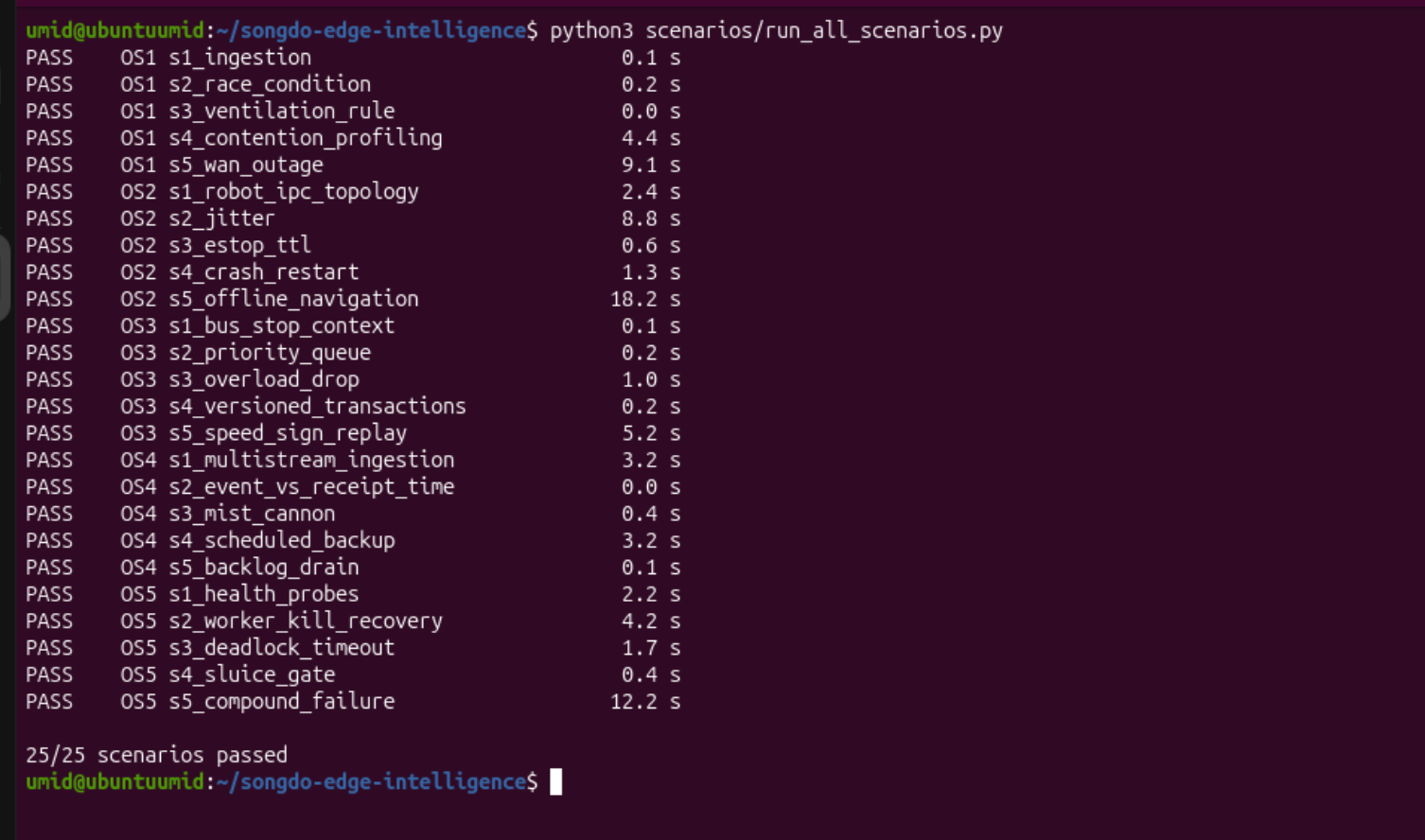
- 25/25 scenarios pass (5 themes × 5 scenarios, all on one shared core)
- 87/87 unit tests pass
- Four 10-minute WAN outages with zero lost and zero duplicated events
- systemd restarts the node 2 s after a SIGKILL
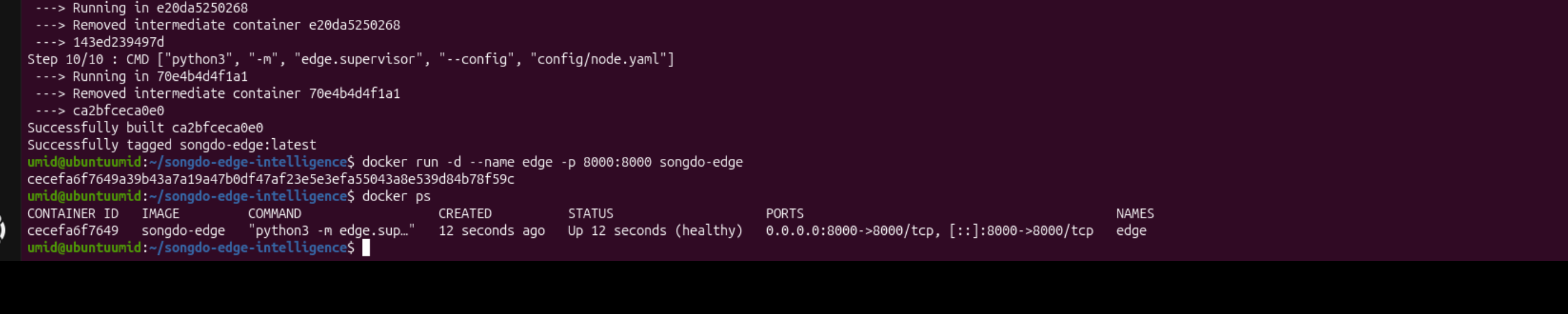
- The Docker container runs healthy
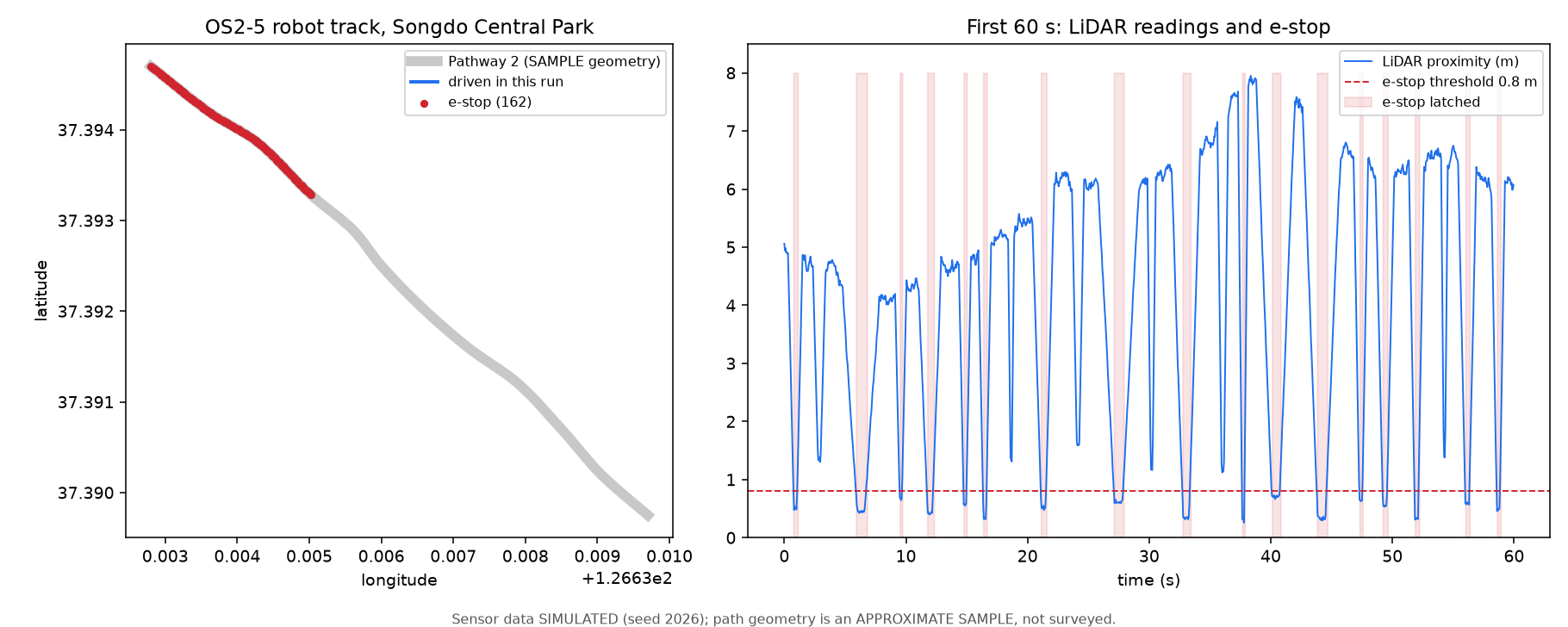
- The robot stopped for 162/162 obstacles while offline
My role
I led a team of 8. I managed the GitHub repo, merged everyone’s work, handled version control and reviewed the other members’ code. I also built OS2, the robot edge controller, together with a teammate.
How it works
SensorGen --(bounded queue, 500, drop oldest)--> Processor --> SQLite WAL (event + outbox in ONE transaction)
HealthMon (/proc -> process health)                  |       local decisions with expiry time -> actuator
API (dashboard, /api/status)                          SyncWorker (drains the outbox only while WAN is online)
Supervisor starts, monitors, restarts and cleanly stops every process.- Separate Linux processes. Each worker runs in its own process. A crash in one can’t corrupt another, and the supervisor restarts dead workers (SIGCHLD +
wait(), so no zombies). - Bounded queues. When the consumer is slow, the oldest reading is dropped, so memory stays bounded and the newest data is kept.
- Durable first, network second. Every reading is written to SQLite together with an outbox row in one transaction. Local decisions never wait for the network.
- Commands expire. Each actuator command has an expiry time on the monotonic clock, so a late command is rejected instead of acting on old information.
- Offline, then drain. While offline, the outbox grows. When the WAN is back, it drains in batches, and the receiver deduplicates by event id. A conservation check (
events = delivered + pending) proves nothing was lost.
OS2: the robot controller (my part)
| Scenario | What it shows |
|---|---|
| Multi-process architecture | LiDAR, Controller and SafetyMonitor run as 3 processes. The controller has a deliberate bug, and the SafetyMonitor vetoes every bad command over a Unix socket. |
| Periodic deadlines & jitter | A 50 ms control loop on absolute monotonic deadlines doesn’t drift, even with CPU-burning processes competing. |
| Obstacle e-stop & command expiry | LiDAR < 0.8 m triggers the emergency stop directly. Commands older than 500 ms are rejected. |
| Worker crash & restart | The motion worker is killed with SIGKILL, and the supervisor restarts it in ~0.1–0.2 s with its state restored from SQLite. |
| Offline navigation | The robot drives a Central Park path with the WAN cut, stops for every pedestrian or dog closer than 0.8 m, and delivers every sensor event after the WAN returns. |
10-minute offline run: 12,000 control ticks (longest gap 89 ms), 162/162 obstacle stops, 0 false stops, 253 m driven, then 24,320 events stored = 24,320 delivered.

Live dashboard
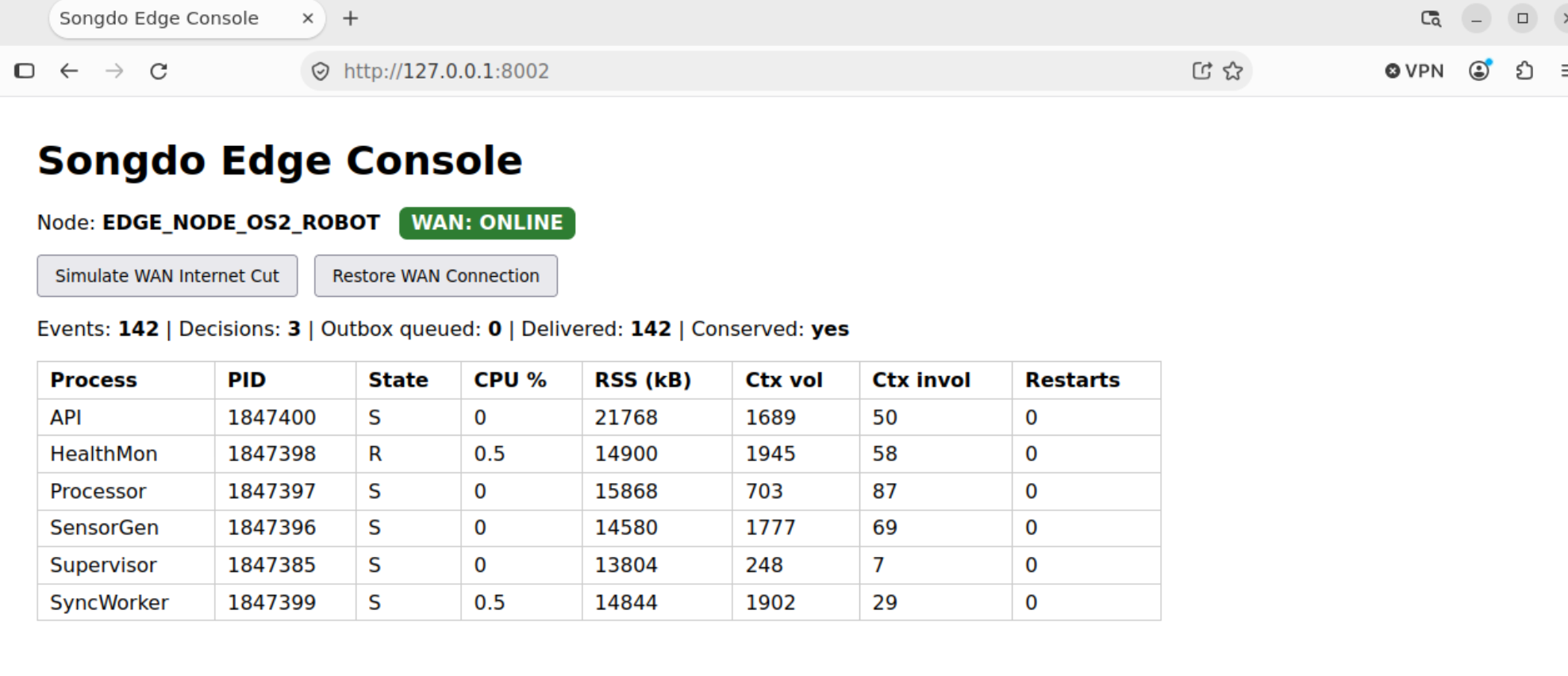
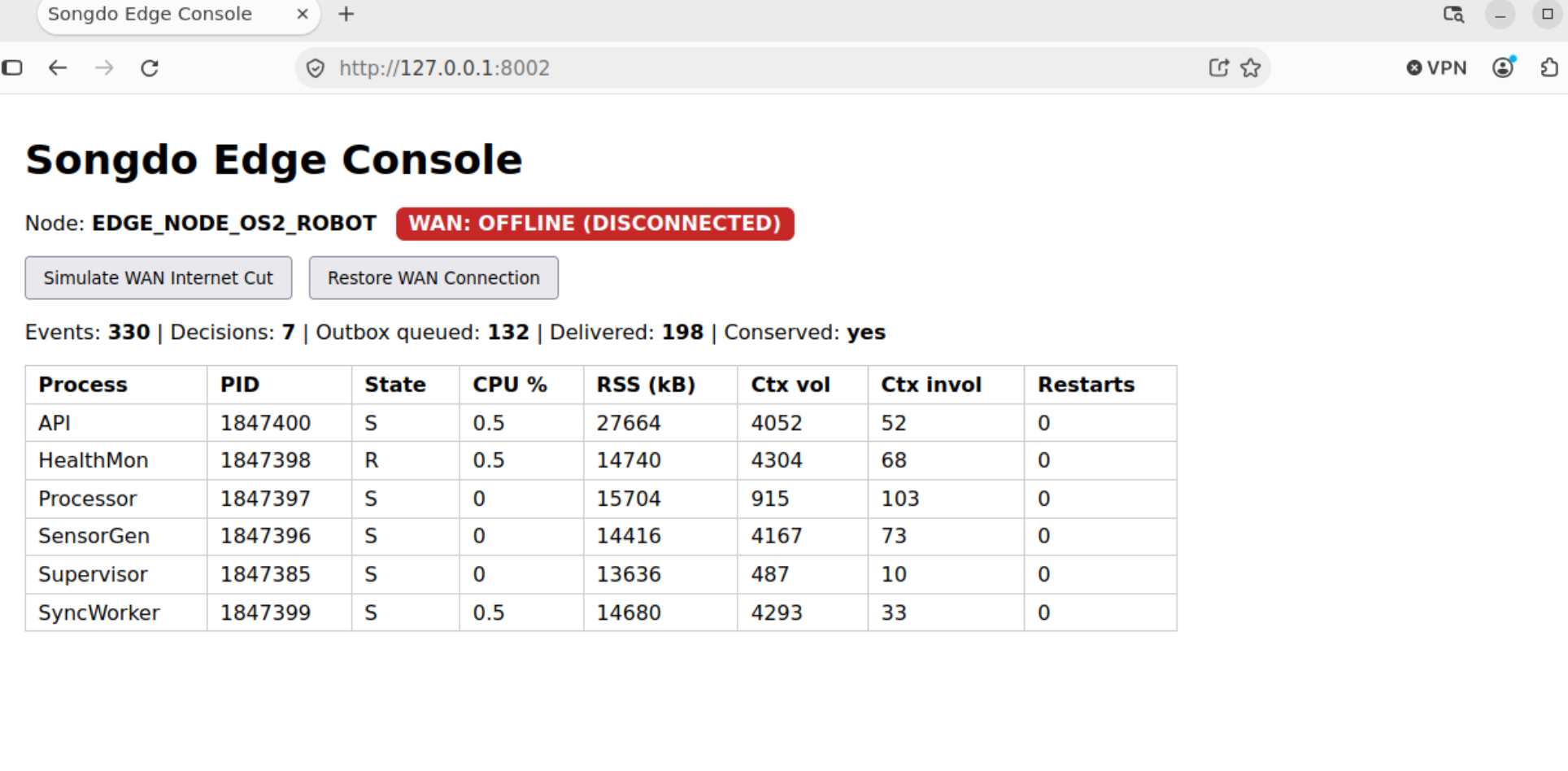
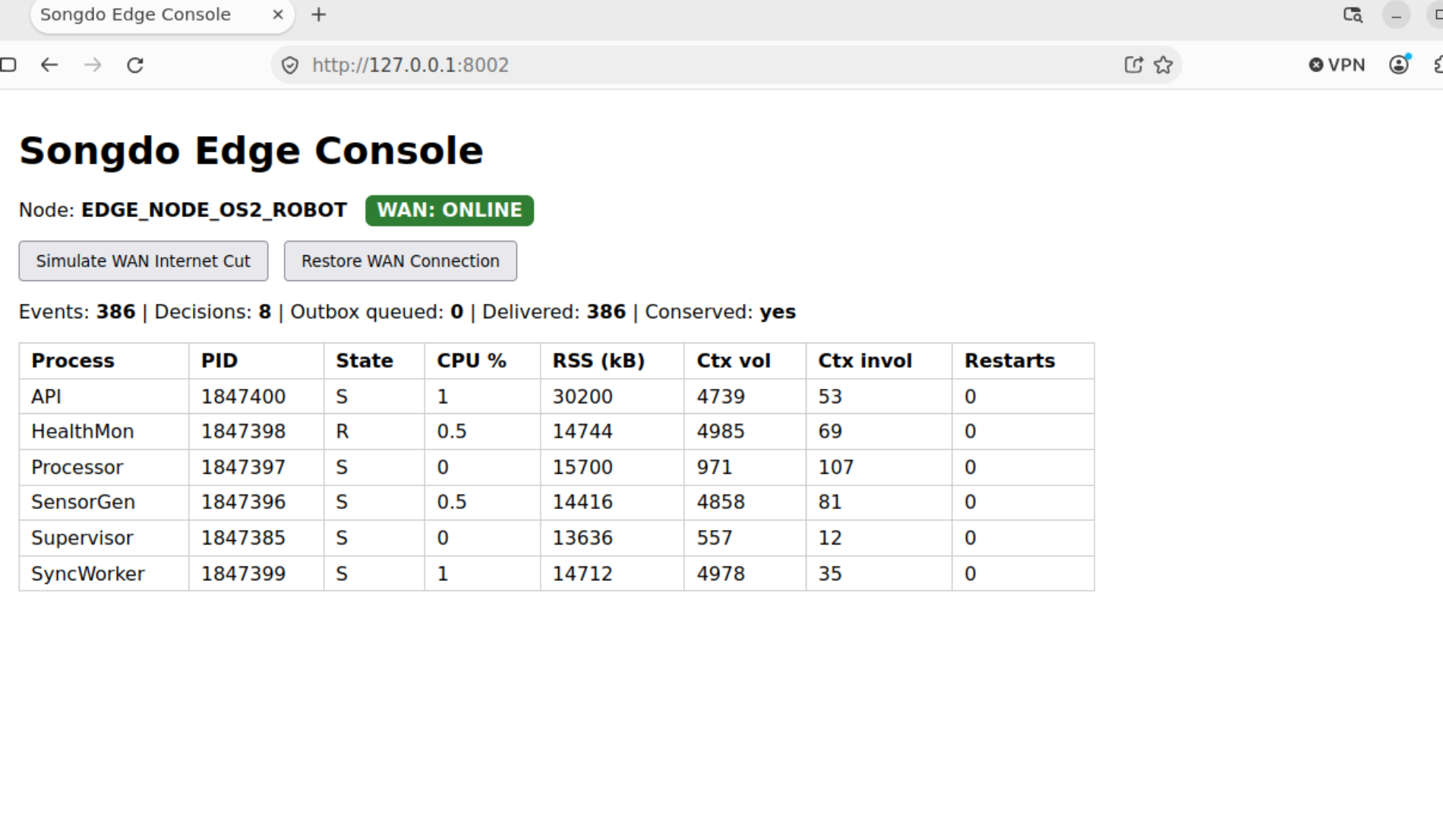
A zero-dependency web console shows every process’s PID, CPU, memory and context switches, read live from /proc.
Online → WAN cut → restored. During the cut, events and local decisions keep increasing, the outbox grows, and Conserved stays yes. After restore, the backlog drains to 0.
Deployment
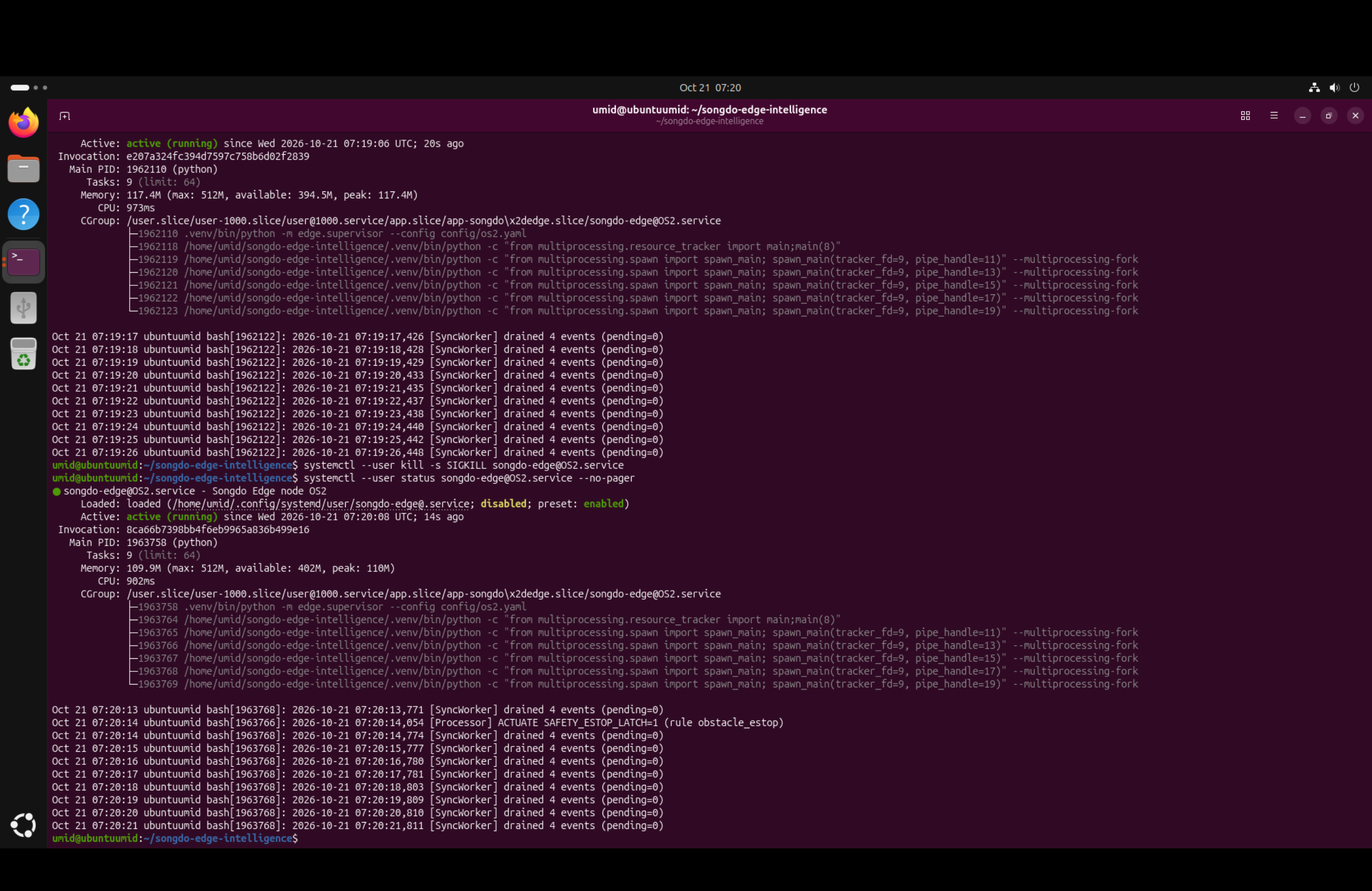
systemd: the node runs as a user service with memory, CPU and task limits. Killed on purpose with SIGKILL, it restarted by itself after 2 seconds.
Docker: a non-root Ubuntu 24.04 image with its own health check reports Up (healthy).