Qaza Tracker
A Telegram bot and Mini App that helps Muslims count, remember and make up their missed prayers.
- Role
- Solo: idea, design, frontend, backend, bot, database, deployment, translations
- Duration
- About 1 month, from scratch
- Stack
- PythonFastAPIaiogramReactTypeScriptSupabasePostgreSQLVercelRailway
The problem
Muslims pray five times a day, and each prayer has a time window that ends. A prayer that is missed has to be made up later, and this make-up prayer is called qaza.
The hard part is the counting. Someone who missed prayers for months or years can owe hundreds of them, and the number changes every day: a new miss adds one, a make-up prayer removes one. Paper notes and memory don’t work for that, and most people also forget the prayer window itself while they’re busy.
What it does
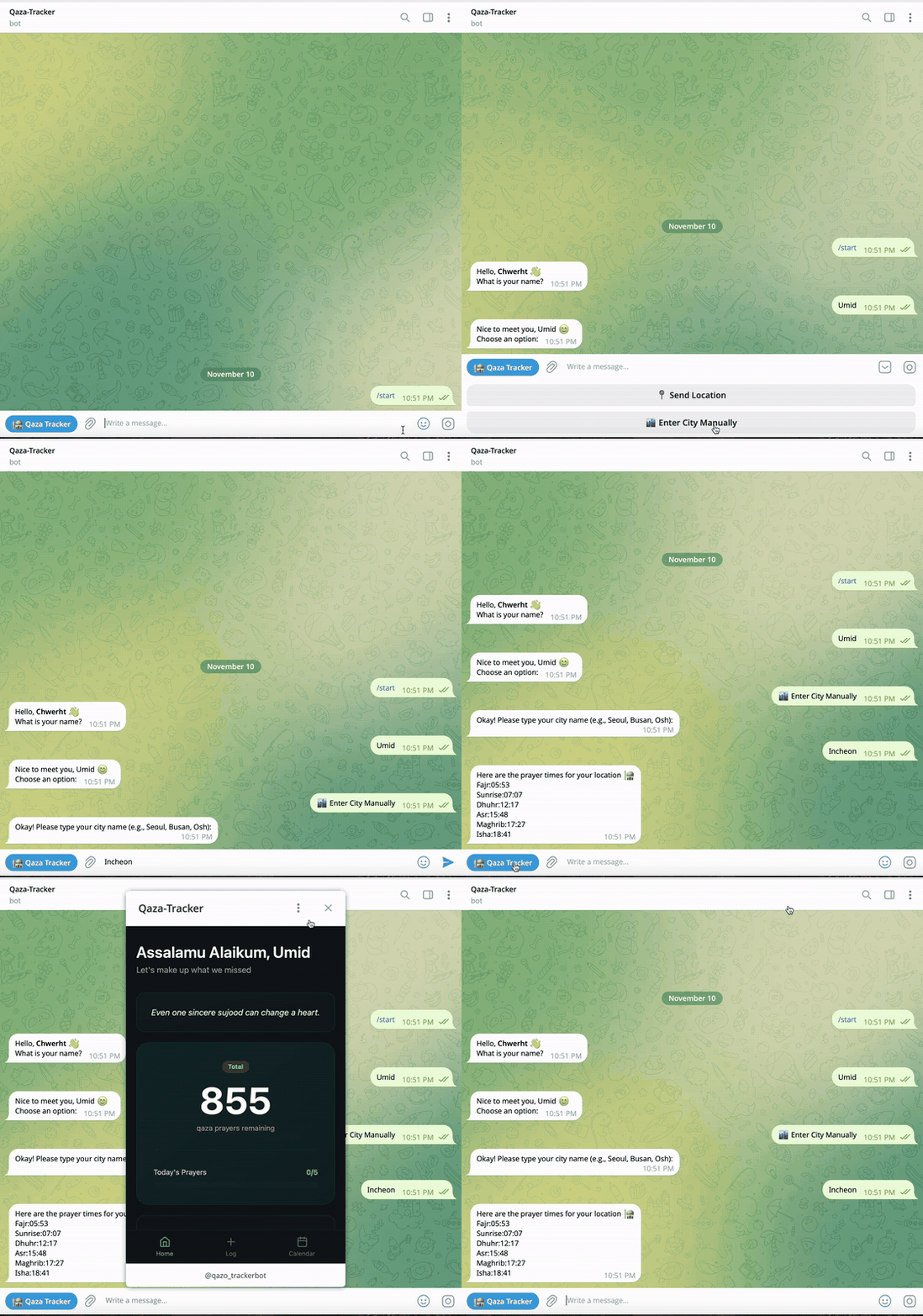
The bot (reminders and recording)
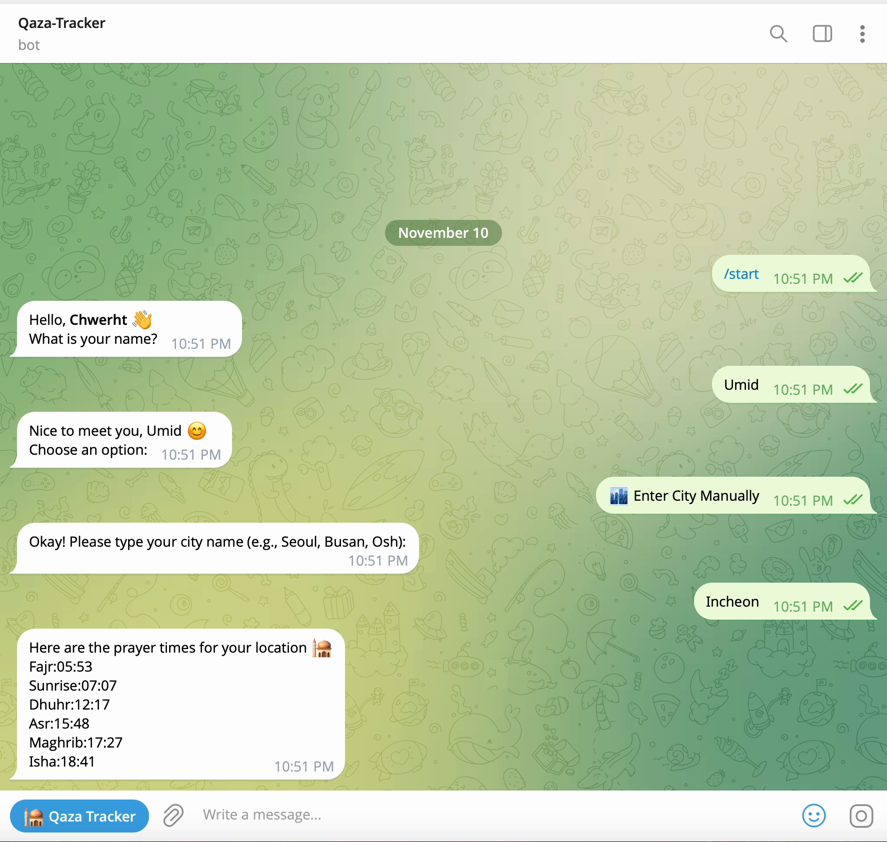
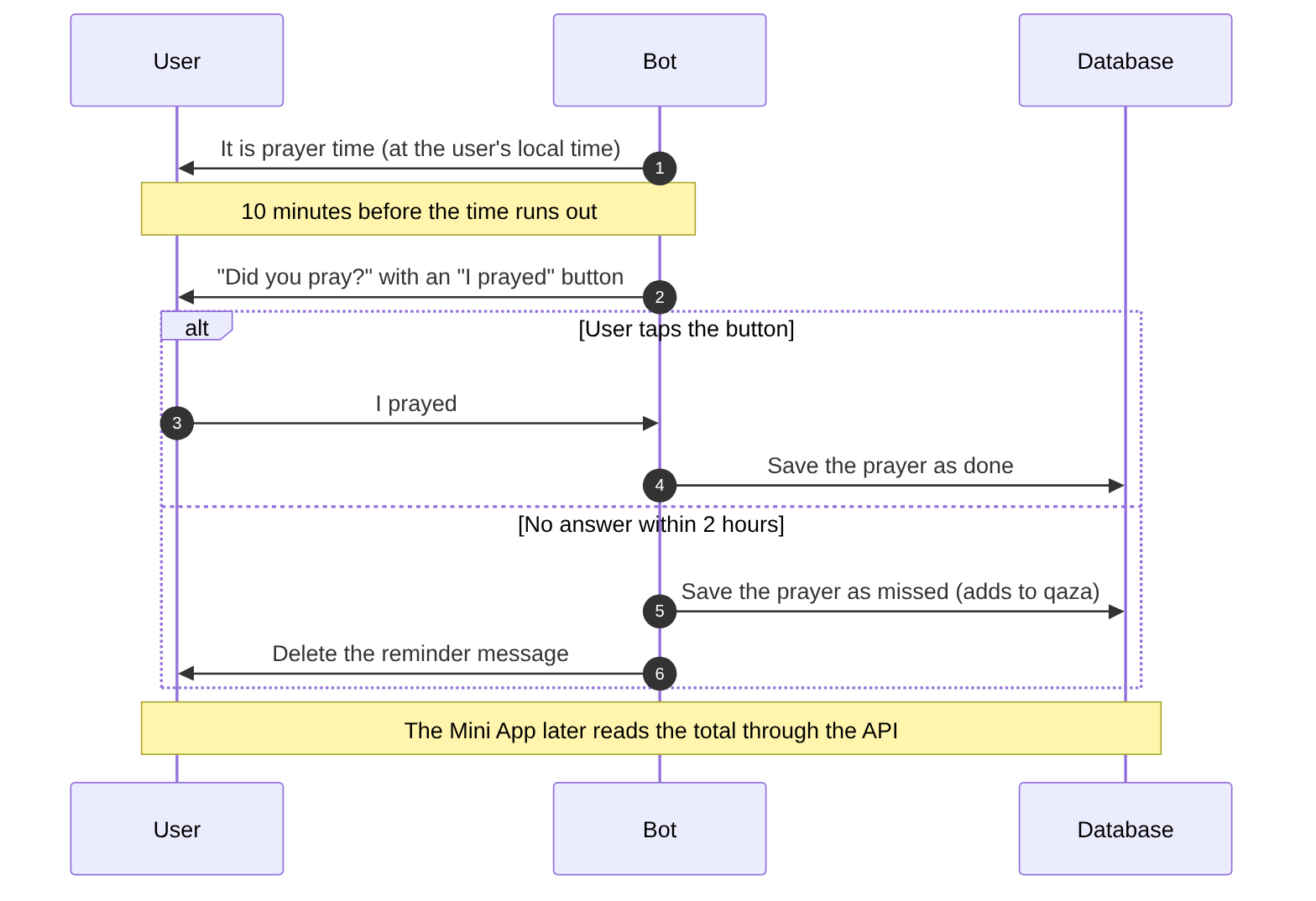
- Sends a message at each prayer time, using prayer times for the user’s own city (Aladhan API, Hanafi school).
- Sends a warning 10 minutes before a prayer’s time runs out, with an “I prayed” button.
- If nobody answers within 2 hours, it records the prayer as missed automatically, so nothing is lost silently.
- Handles each user’s time zone (found from their location) and speaks several languages.
The Mini App (the numbers)
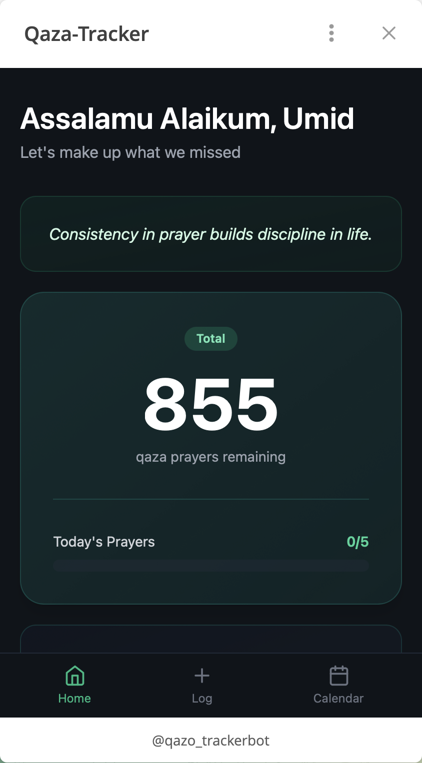
- Home: how many qaza prayers you still owe, and how many of today’s five you’ve prayed.
- Log: mark today’s prayers as prayed or missed (with a reason), add old missed prayers, and clear qaza prayers you’ve made up.
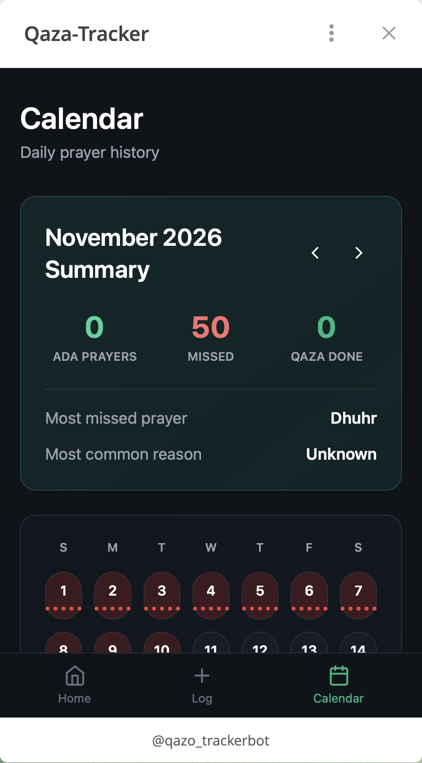
- Calendar: a monthly summary, your most missed prayer, the most common reason, and a day-by-day history.
Architecture
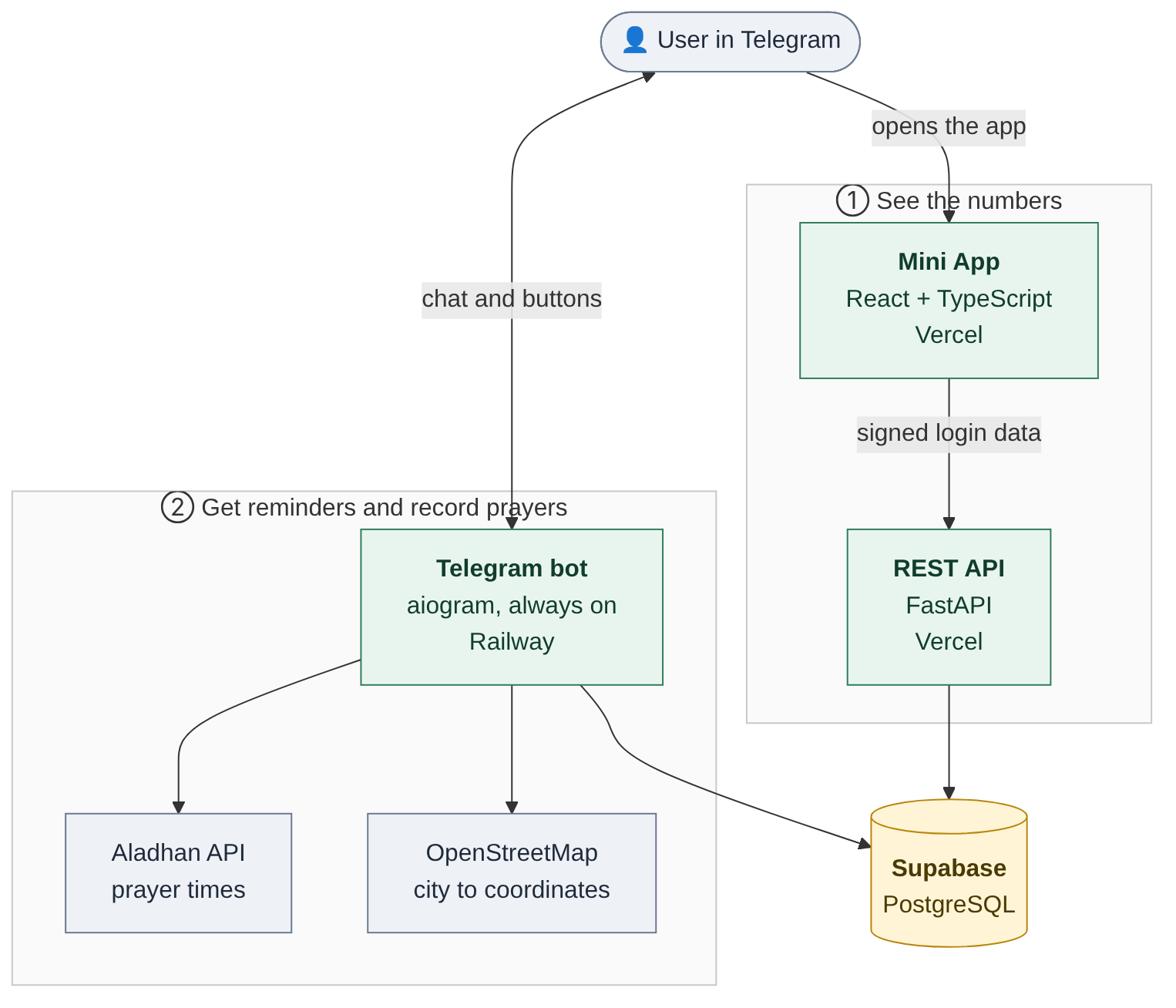
Two separate parts share one database. The Mini App (React, on Vercel) is where a user sees the numbers and talks to a FastAPI backend. The bot (aiogram, always on, on Railway) sends reminders and records prayers. Both read and write the same Supabase PostgreSQL database.
What happens for one prayer
Database
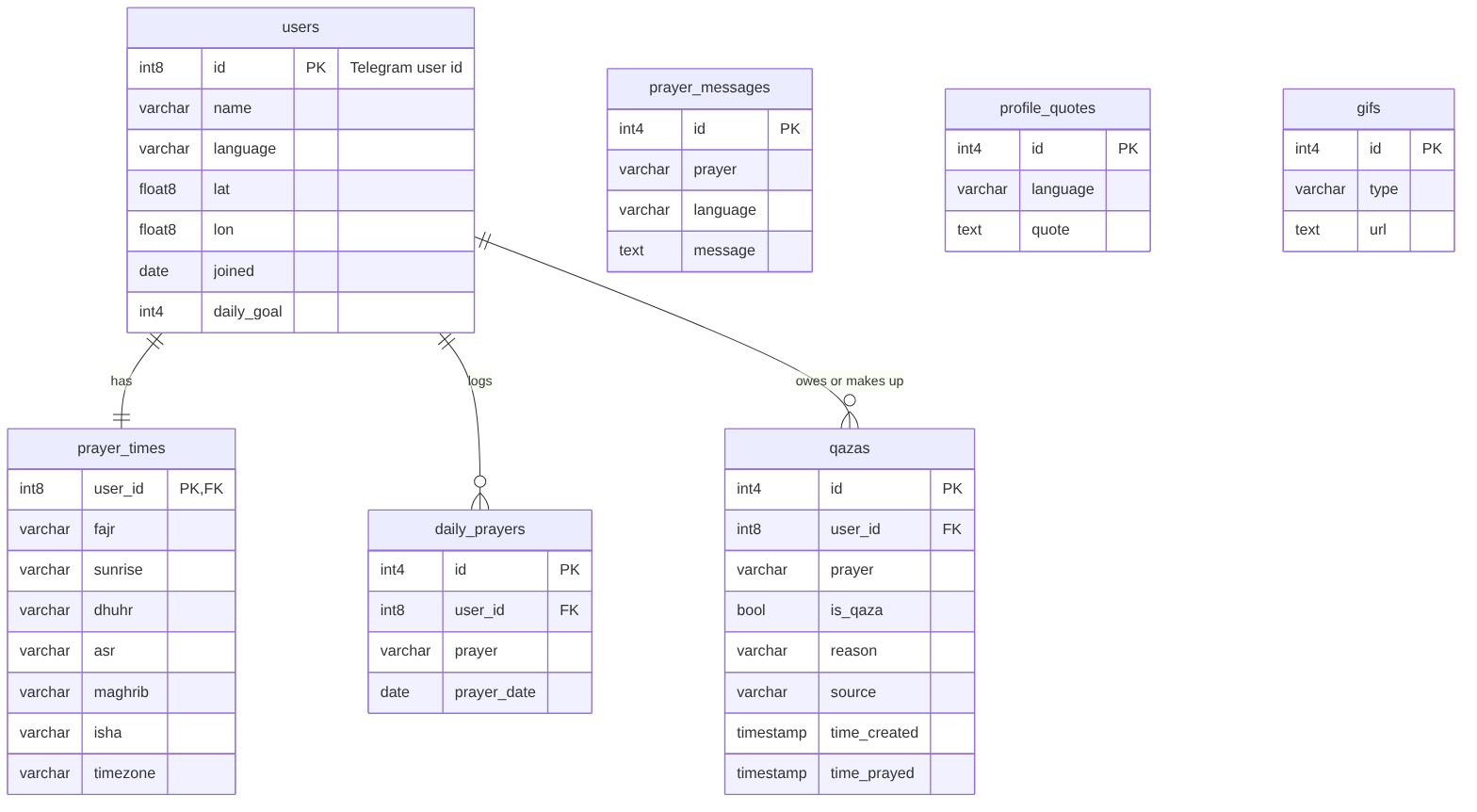
Supabase (PostgreSQL), 7 tables. Everything about a person hangs off users, whose id is the Telegram user id.
Problems I hit and how I solved them
1. A reminder was silently lost. The bot remembered only one pending reminder per user, so a second reminder overwrote the first and that prayer was never marked as missed. I changed it to track pending reminders per message.
2. Random ConnectionTerminated errors from the database. With many scheduler tasks running at once, the Supabase client’s HTTP/2 connections kept getting terminated. Forcing HTTP/1.1 fixed it.
3. The bot crashed on startup with Illegal header value. A hidden trailing newline in an environment variable broke the request header. I now strip whitespace from every environment variable.
4. Deployments failed on dependency versions. pydantic-core had no build for Python 3.13. I pinned Python 3.12 and the pydantic version.
5. The API trusted whatever user id it was given. A stranger who guessed a Telegram id could read someone else’s data. I added Telegram’s signed initData check: the backend recomputes the signature with the bot token, rejects stale data, and only allows users to touch their own data. It has 14 tests, and I rolled it out in log-only mode first before enforcing it.
6. Simplifying the product as I used it. I merged the Profile page into Home, removed stats that weren’t useful, and simplified the “missed reason” options.
Results
- Live on Telegram with real users.
- Three services (Mini App, API, bot) deployed from one monorepo.
Next steps
- Share the database code between the API and the bot instead of keeping two copies.
- Add automated tests for the reminder logic.
- Support more prayer-time calculation methods.